The feasibility of a whole-cell model of the human platelet

Steve Haigh

21 May 2026

Quick recap

What I evaluated

  • Aiming to build a computer model of the platelet.
  • Has been done before in prokaryotes and yeast but not in other eukaryotic cells.
  • Lots of modelling done in platelets but not a whole-cell attempt.
  • Lots of options e.g., COPASI, V-Cell and others.
  • Landed on wcEcoli project from Covert lab — capable of scaling to whole cell, code quality excellent, something I could work with and expand.

What I did

  • Forked wcEcoli (i.e., took my own working copy).
  • Pruned all E. coli biology.
  • Used AI to build tests to verify I didn’t remove too much.
  • Rebuilt cell contents and processes from the platelet literature.
  • Kept the simulation engine, state partitioning, listener / analysis framework.
  • ~5,000 lines of working code I didn’t have to write.
  • Emailed Prof. Covert — “sounds fun, good luck”.

Method to build a calibrated model

For each mechanism, a five-step process:

  1. Anchor paper. E.g., Dolan & Diamond 2014 supplied the validation experiment (Fig. 4 Ca²⁺ transients ± extracellular Ca²⁺) and resting-state targets (100 nM cyt, 250 µM DTS).
  2. Literature review for kinetics. Primary sources: deYoung–Keizer 1992 for IP₃R, Caride 2007 for PMCA, Hoover & Lewis 2011 for SOCE, Mazet 2020 for the PI cycle…
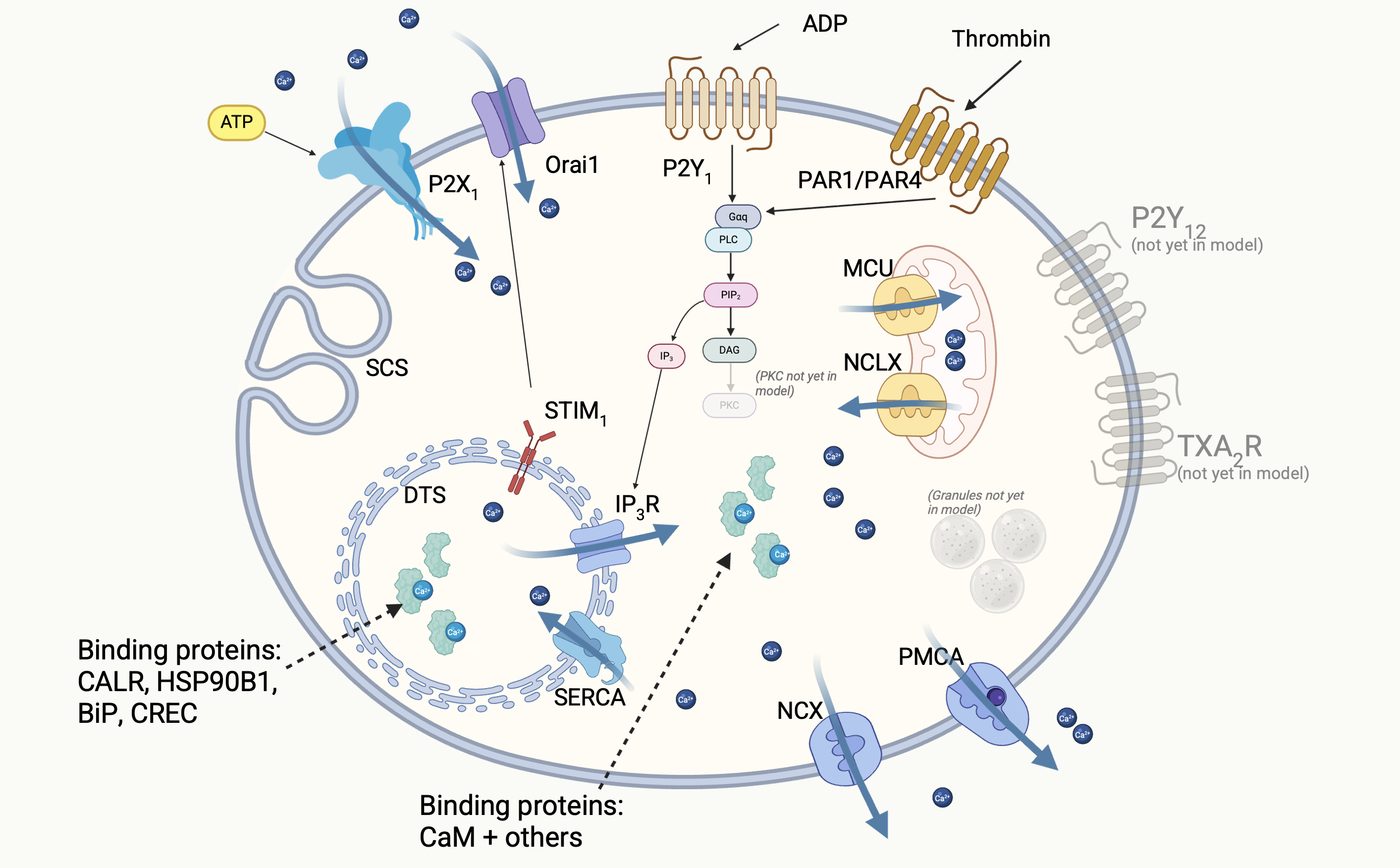
  3. Species enumeration. Every Ca²⁺-binding or -gating protein state, with a compartment tag (DTS, Cyt etc.). ~50 species for the calcium pathway.
  4. Copy numbers from Burkhart 2012 platelet proteomics.
  5. Rate constants. Primary-source values, units normalised, every value carrying a citation comment in code.

Then: does the resting state hold? Do the timescales line up? Do the unit tests still pass?

Build code from source data — start with the data

Start with the published data (usually PDF, sometimes CSV).
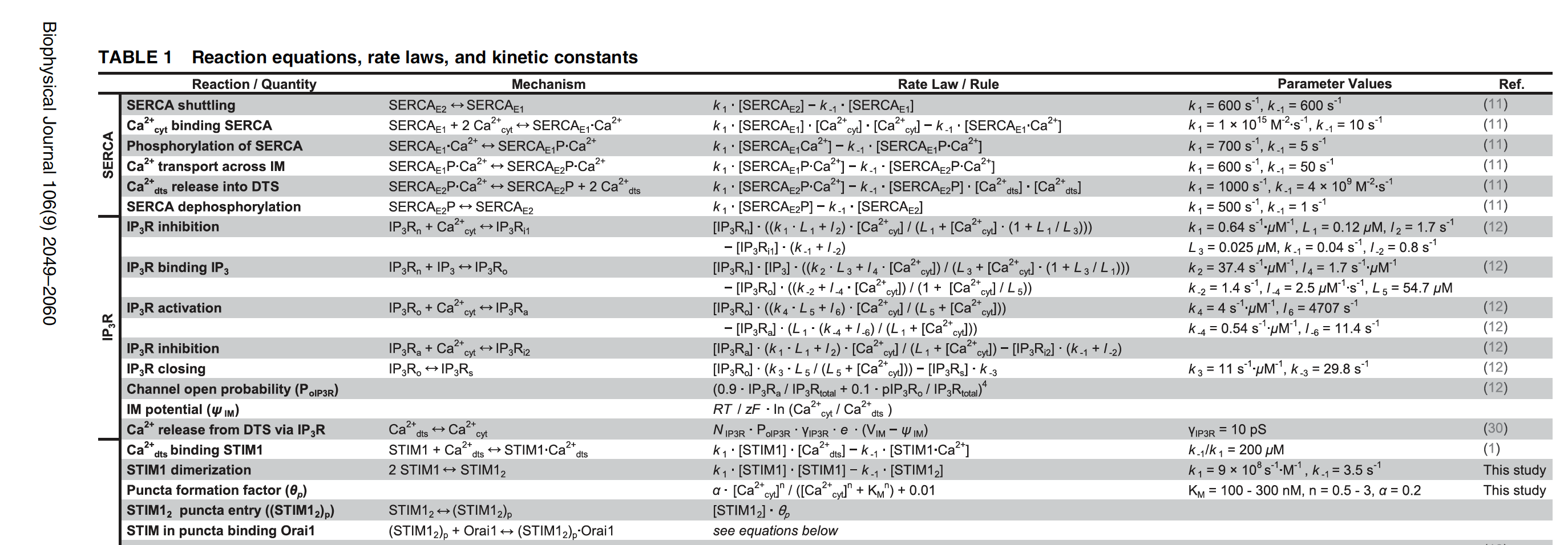
Just a small excerpt.

Build code from source data — AI extraction

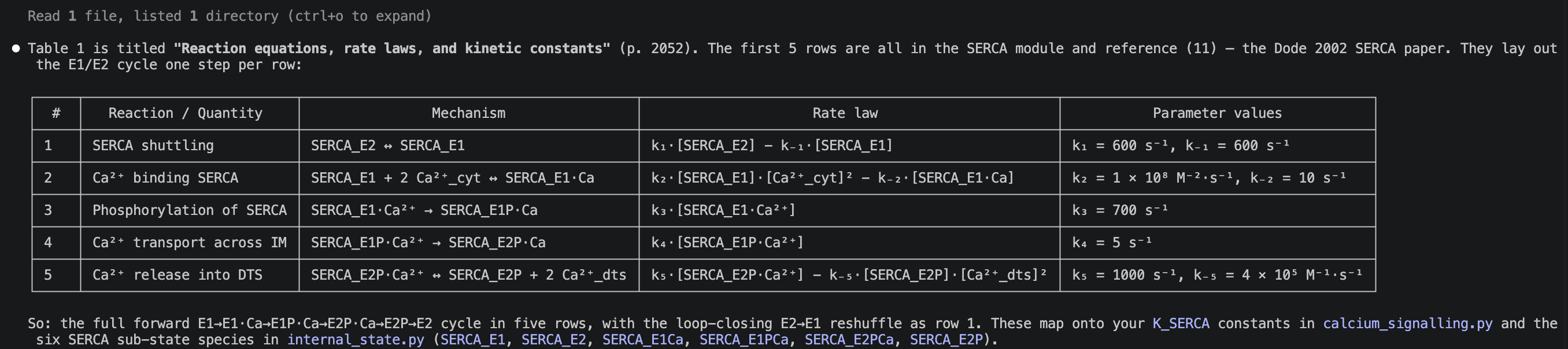
Ask AI to extract — get it to tell you what it’s doing to sanity check (but it is very good at this).

E.g. I asked: “Please read Dolan and Diamond 2014 and tell me what the first 5 lines of table 1 show.”

Simply not feasible to do this by hand at large scale; AI could process 100s of papers in a day. The only challenge is verification, but this is also amenable to AI assistance.
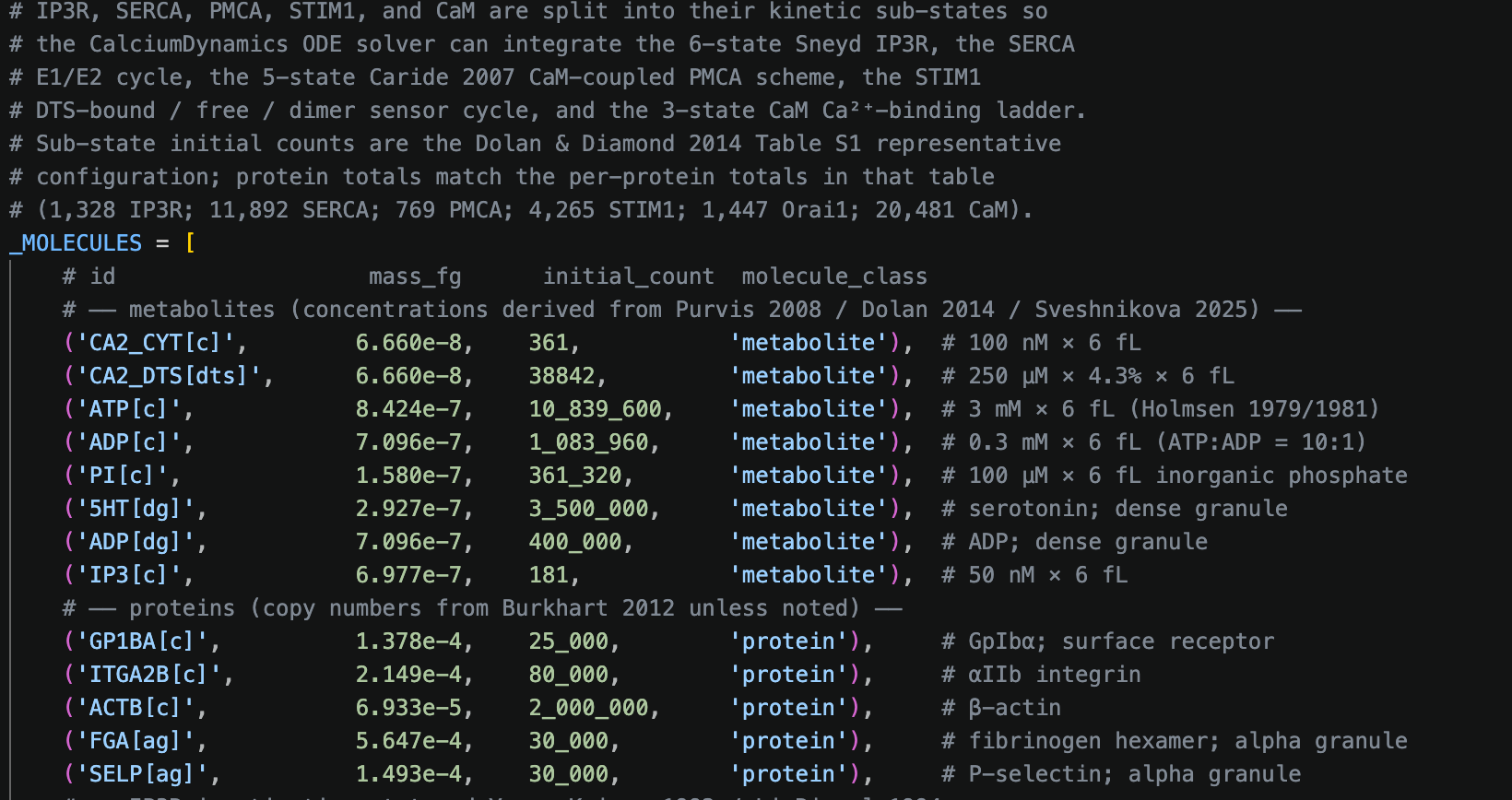
Build code from source data — AI writes the code

Then get AI to build the code, using the wcEcoli code as a template.

The code works well, the architecture is not perfect — needs some work to make it more usable for future expansion — but it’s an excellent start.
What did I build? (so far)
Spotting errors in the source

The Purvis 2008 k₃ story.

  • Asked AI to check values it had extracted.
  • AI spotted that a value quoted in Purvis & Diamond 2008 (a well-known platelet modelling paper) was wrong — units were wrong and value was 100× too large.
  • AI found the original study via the references and I verified for myself; AI was correct, there was a typo.
  • Very strong use-case for AI — tracking values and assertions across papers. Also very useful for helping to review data: I got the AI to print values it had found, with reference to the primary source and the code, so I could easily review.

Validation

Criteria

Compared output to existing models. Success criteria:

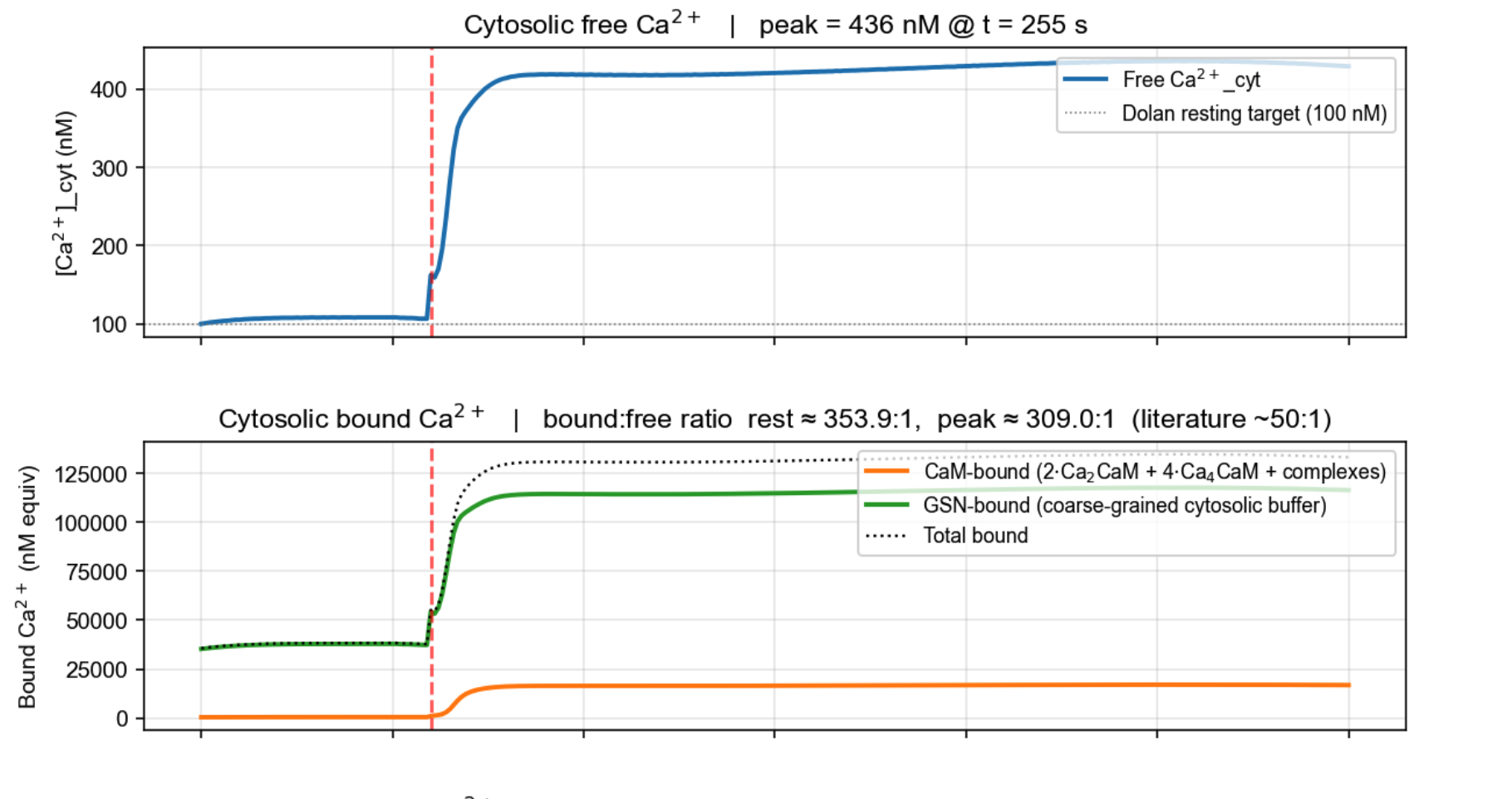
  • Resting cytosolic Ca²⁺ within 100 ± 10 nM band
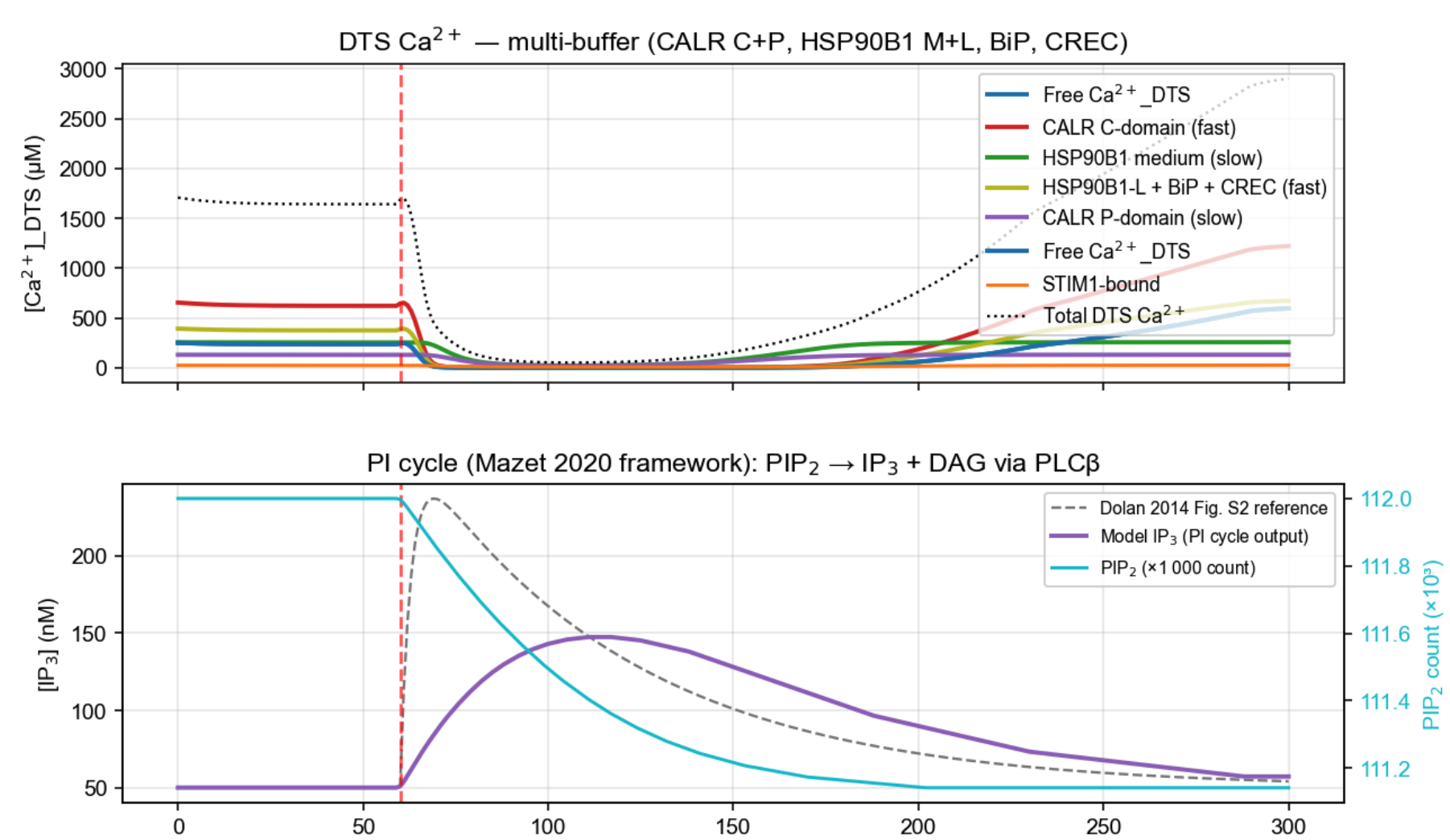
  • Resting DTS Ca²⁺ in the literature range
  • IP₃-stimulated transient peak height in band
  • Transient duration matches shape of previous model(s)

Model state at 14 May

  • Resting cyt Ca²⁺: 104 nM ✓
  • Resting DTS Ca²⁺: 235 µM ✓
  • Resting IP₃: 50 nM ✓
  • Resting Gαq-active: 100 of 5000 ✓
  • 21 / 21 unit tests pass
  • Driven by physiological agonists — 1 nM thrombin, 10 µM ADP. No hand-fitted IP₃ forcing.

Model stimulated with ADP / thrombin — cytosolic Ca²⁺
Model stimulated with ADP / thrombin — DTS Ca²⁺
Where it goes from here

Near-term biology

  • Granule release — the model currently stops at the Ca²⁺ peak.
  • Implement P2Y₁₂, TXA2R receptors and more, depending on time.
  • Run experiments e.g. when P2Y₁₂ / Gᵢ are wired up, add clopidogrel as an in silico drug experiment.

Wider impact

  • Platelet–CTC interactions. A calibrated platelet model could in principle be coupled to a tumour-cell model.
  • Methodology generalises to other single-cell calibration problems — if pathways are well-quantified, no reason not to try modelling them in a cancer cell.
  • Multiple cell–cell interactions — thrombus formation?

Blue sky goal

  • I’d like to get to a point where a biologist with limited coding experience could build a model with AI help. Very long shot: a system where a user drops primary data and text instructions into an app and the model builds itself.